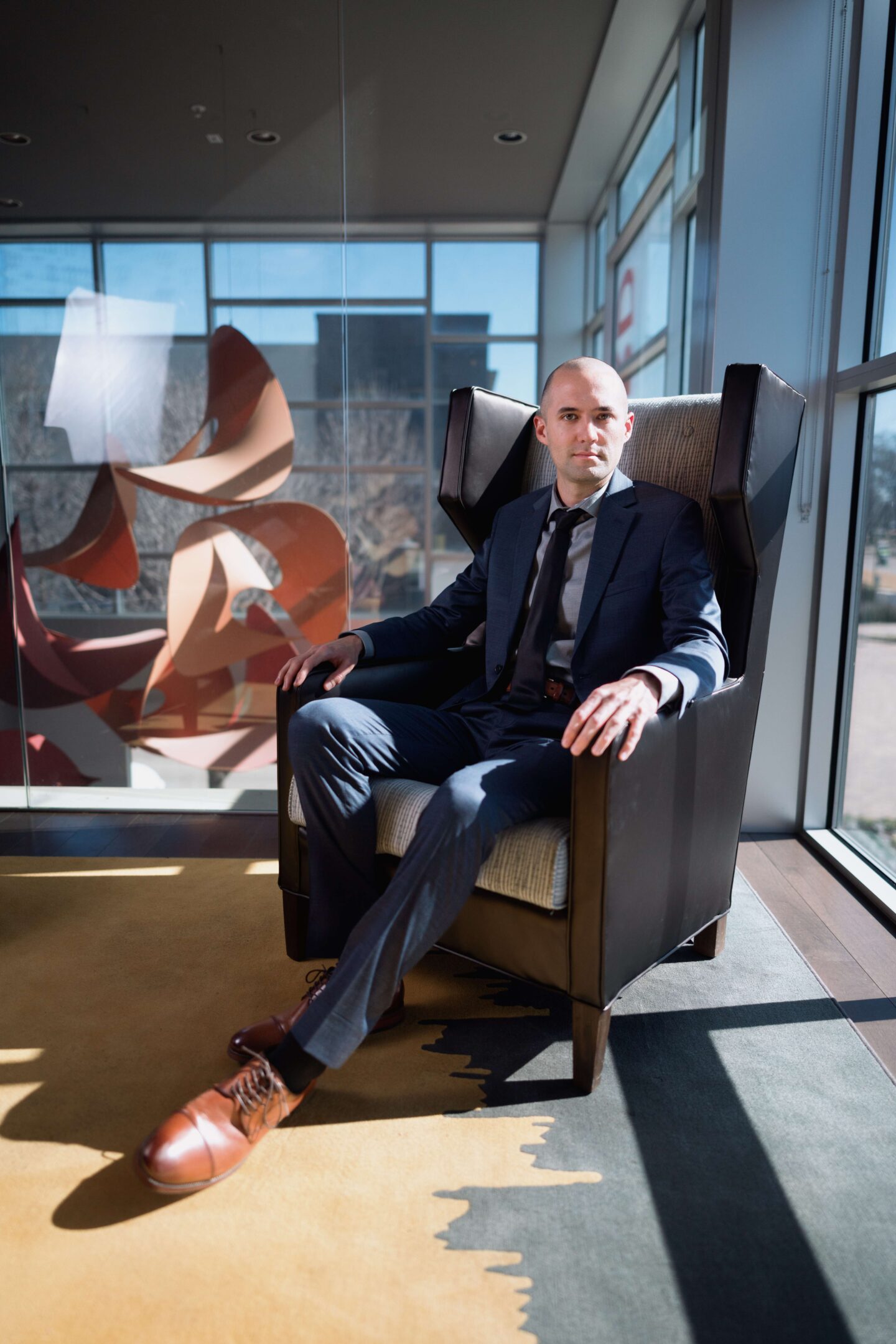
Meet Blair KH Naujok: the Founder and Director of the ‘Korean Image Archive’ – who has since the archive’s official opening in 2021 carefully collected and preserved a truly amazing collection of historic images of Korea.
The archive’s mission is to strengthen and enrich the connection modern-day Korea has with its past. It does so by creating high quality digital copies of the historic images amongst its collection so that they are preserved and protected for the future. Once this task has been completed, the images are inspected so that the archive can glean as much information and history as possible. This labour of love makes the Archive a valuable resource for anyone seeking to understand Korea through its 20th-century photographic history. The archive’s other area of focus is to serve as a trusted resource for artists and academics seeking historical images and materials to supplement and enhance their projects. The archive is “always happy to facilitate image requests because we understand the historic and cultural value each image contains. Each person who uses these images further conveys this value to others and additionally brings new historic understandings to light.”
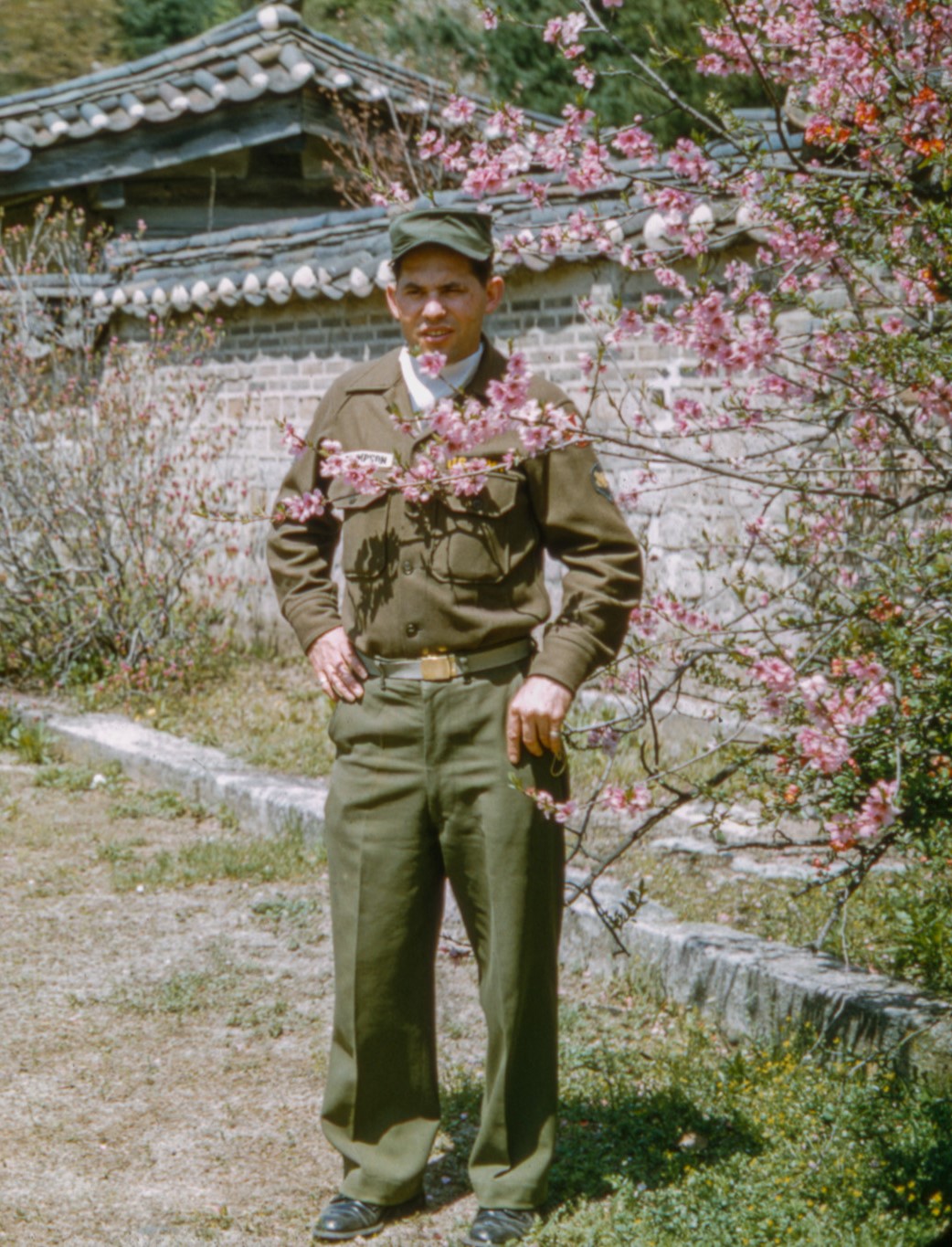
Our conversation began with the interesting family story that lies behind, and at the very heart of, the collection. Whilst the archives officially opened in Autumn/Fall 2021, Blair shared with me that the true origins of the archives take us back to 60 years ago. At this point in history, Blair’s grandfather, Allen Blair Thompson (pictured right) was stationed in South Korea as a helicopter mechanic with the US military. During his deployment, he took wonderful photographs on 35-millimetre colour film. Blair shared with me that he feels his grandfather “had an affinity for art. He enjoyed painting and sketching, but as that involved material is very difficult to transport, especially when you’re in the military, it was probably much easier for him to grab a camera, and a few rolls of film, and take them over to Korea.”
The photographs held by the collection are truly incredible, and it is exciting to see history come to life. The images taken by Blair’s grandfather, Allen Thompson, show a real knack for capturing people in a natural way – there’s a sense that he was able to build a rapport with the people he photographed to show a scene as it was, but there’s an added element of curiosity and playfulness in those where the subjects are individuals. For anyone who has had the pleasure of speaking with Blair, it doesn’t take long to appreciate his candor, and he, with his engaging positivity, is in possession of the same spirit and energy I imagine his Grandfather possessed. Among the collection (the Eisenhower Collection in particular) there is a photograph of two interesting-looking gentlemen sitting in a park, enjoying their afternoon. Blair shared with me that a photograph was taken in Seoul circa 1952, which you can see if you click here. There’s a lot of personality in this photograph. The men, presumably friends, look a little surprised, quizzical even but “it is clear,” Blair added, “that he (Thompson) had a consideration for them. They’re not uncomfortable and seem absolutely fine with him being there. It shows that he must have taken a bit of care as he was out and about doing the photographing.”
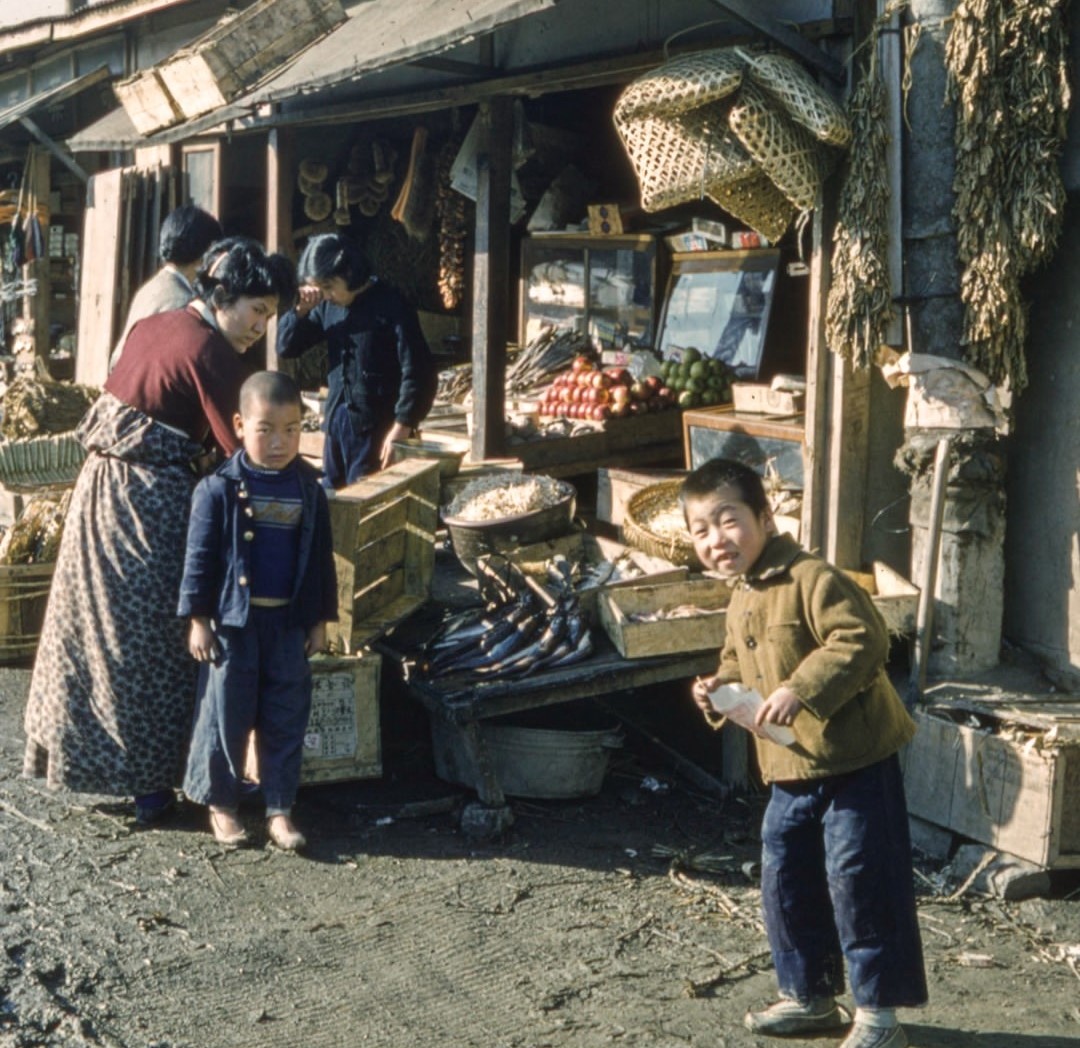
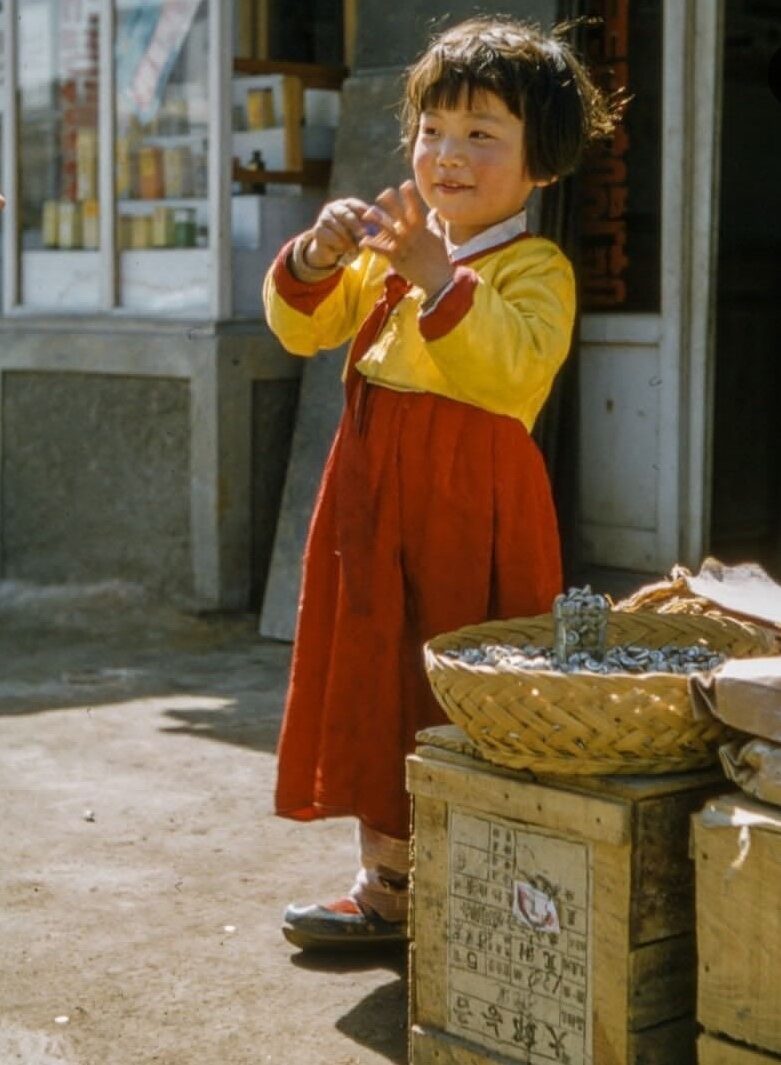
As Thompson passed away before Blair was born, Blair sadly did not know of the existence of the photographs growing up, nor did he have the opportunity to later talk to his grandfather about the photographs directly. Fortunately however, Blair is and remains very close with his grandma, through whom Blair gains his Korean heritage. His grandparents met during the time his grandfather was stationed in Korea (1957-61). His grandma’s family had resettled to an area near the military base at the time. Blair shared that his grandfather would stop by her family’s grocery market (which would have been similar to that in the photograph on the left) every day to buy apples, “or,” Blair added with a smile, “at least that’s what he said, but I think he just wanted to talk to her.”
Fast forward to when Blair returned to the US after having lived in Korea. “One day,” Blair shared, “my grandmother presented me with a plain looking cardboard box and said ‘these are photos that your grandpa took’ without much fanfare. I was a film major in school, so she thought I might like to see them. When I opened the box I found lots of 35 millimetre slides.” Blair described what followed in a manner that allowed me to picture it as it unfolded. Not having “a projector to hand, I used a flashlight. As I looked through the images I realised that they weren’t just images of the US back in the late 50s or 60s, but of Korea.”
This discovery is something that Blair describes as being notable, as he had not before seen many colour images from Korea from that time period. “I thought,” Blair continued, “it’s great that I have these, but it’s kind of a shame if this type of photography is so inaccessible. These kinds of images are so rare. Maybe I should do something about that.” Which he did, and after investing in a scanner later that year, Blair was able to bring the digital images with him back to Korea and show them to people he knew: friends, co-workers, colleagues, all of whom where very surprised to see Korea in colour.
At that time, it had been Blair’s plan to live in Korea permanently, but things did not work out as planned and he moved back to the US in January 2020. The pandemic followed shortly afterwards, halting Blair’s plans. “Having just moved home,” Blair shared, “and finding myself in a transitional space, I had not moved on to anything else [before the pandemic happened]. I spent a lot of time thinking about what I was going to do with my life now. Instead of just sitting around, I wanted to try and make the most of it.”
Fortunately, Blair was in possession of the aforementioned 303 hundred colour slides from his grandfather and was able to put his energy to good use. “I had,” Blair continued, “a little bit of experience [in this regard] so I decided to see what happened. I organised the collection, and got in contact with one of my former advisors from the film archive with whom I had worked as a volunteer for two years during college.” Fortunately, she was able to answer all the questions Blair had, and generously stepped in to offer help, which allowed Blair to gain a better understanding of what running an archive entails. Together, they began to digitise the collection, and after a lot of time and effort, the archive has now over 2500 on file. Whilst Blair may have left behind a career in film and video production, one can’t help feeling that the universe was gently guiding him in the right direction until such time as he was ready to say ‘OK!’, and take that step to create the archive as we know it.
Organising a digital collection is no mean feat, and Blair deserves high praise for having completed that task. Less of task, more of a labour of love. The archive has 27 main subject categories (architecture, transportation, people, etc), and those breakdown into 170 sub-galleries. Then (!) Blair divided the collection by location and time period. Having undertaken this task, Blair is able to say with some degree of certainty that these photos were taken “probably by the same person or a small group of people who were all doing the same thing at the same time at the same place”. The photographs taken by Thompson were mostly taken around the base where he was located in Incheon. There are, however, also some from where he was transported to during his second tour in Korea. Among these are the ‘Lyndon B Johnson collection‘, which features 20 photos of the day when Johnson visited Seoul. Thompson took pictures of the parade as people were waiting for Johnson to arrive. “The visit ended,” Blair shared, “with a dedication ceremony for a place called Johnson. These photographs document the agricultural developments that were going on in the area at the time.”
We then spoke for a while about Blair’s Korean heritage. Blair, being fourth generation Korean, commented that “whilst I may not really have any evidence of that on my face, I’ve learned that’s not too important. I know where I come from. I know the connections I have with my family, what I’ve learned from them and what’s been passed down to me.”
The time Blair spent in Korea is something he describes “as the most formative period of my life”, and it is very important to Blair that he was able to connect with people and part of his family’s culture. Talking of this with me, Blair shared that “before I graduated from college, I was at the stage where a lot of people are thinking about what comes next. The opportunity to go to Korea and learn a little bit more about my family presented itself. I was encouraged by Asian American friends who were on their own paths trying to understand their own heritage. So I moved [to Korea] full of youthful confidence, not having visited before or knowing very much of the language – I knew maybe fifty words in Korean – which definitely felt intimidating but I found people who really took care of me along the way.”
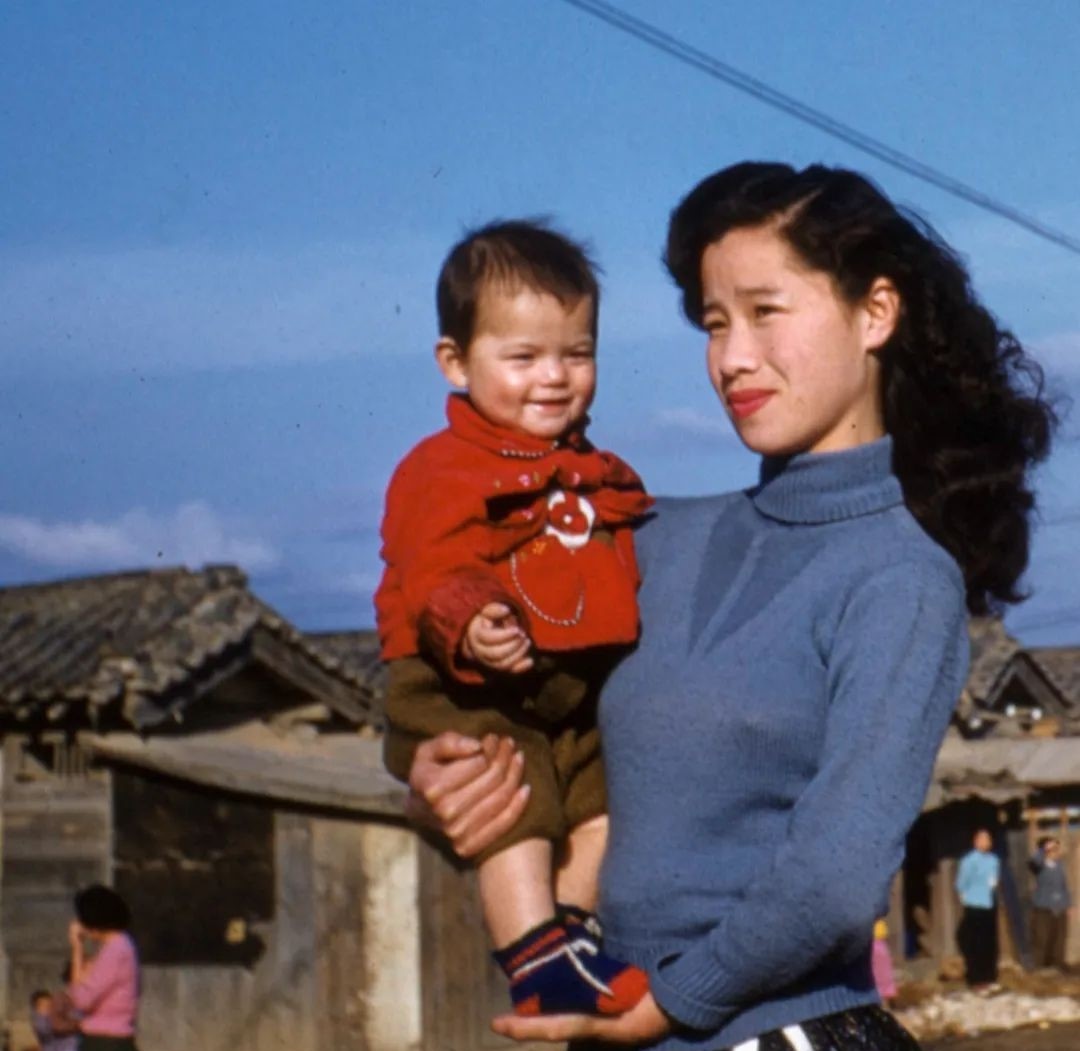
It is for this reason, that Blair considers the image you see on the above left as being one of his favourite amongst the collection. This image features a mixed heritage child in his mother’s arms. This is something that Blair regards as being “really special to see. I didn’t know many Koreans growing up. I only really knew my Grandma. Seeing evidence that there are more people like me out there acts as way of knowing there is a history of mixed Koreans. It gives me a more complete sense of the world and a better understanding of how to interact with it. That was probably the most special thing to me about my time there [in Korea]. I gained a fuller sense of who I am, and a better understanding of what’s possible for me. I want to stay connected to that now it has become a part of me and shown me a different way to interact with and experience the world. I have to keep that going.”
Whilst it is a near on impossible task to identify the individuals featured in his grandfather’s photographs, I was delighted to learn that Blair has been successful in identifying some of the locations. “That was,” Blair shared, “actually the last thing I did before leaving Korea. A few of them were very easy to find,” Blair added, “like the South gate. You know immediately. Other locations were more difficult. Those with mountains in the background. Whilst some look distinct, others don’t, and I’m no Mountaineer. I was able to locate the neighbourhood where he (Thompson) was based, because of the military patch he was wearing. When I looked that up, it led me to the discovery that a lot of the U.S Army was stationed in Incheon at the time.”
This discovery prompted Blair to pay the place a visit and by good fortune found that on the day he “showed up, that the military base was actually open to the public. It had actually been shut down for years, but that day they were doing a festival to talk about the history. Inside was a display showing similar images from around that time period in colour run by a local historian.” It is a great part of the connection Blair seeks to foster through the archive. Talking of this, Blair described that it felt like an incredible thing be standing where his Grandfather had stood all those years ago. “Finding the locations where my grandfather appears in the photo was an incredible experience because I had never met him in person.”After this fateful meeting, Blair was directed to several of the places, and he made a film about revisiting the locations and seeing the traces that remain. Another happy outcome of this meeting was the aforementioned Historian (Park Myung-sik – also Director of the Bupyeong Cultural Centre) applying for a license to use several of the images in his history book, ‘Traces of Memory’, something which is a source of great pride to Blair.
“As the archive grows,” Blair shared, “I hope we’ll have a historian go through the images and specifically focus on fashion and textiles, explain more about them. As I’m not a Korean historian there is not a great deal of contextual information I am able to provide.”
Blair’s focus for the archive at present however is to continue to build the collection, and he works hard to locate new images. This involves visiting antique stores, looking at online auctions, even attending military shows (big in the US). He also strives to find ways for others to use these images. Blair doesn’t intend for the archive to become a static collection where everything just exists: he wants to get the message out there and feels its necessary for others who might know more about these images or might be able to speak through these images to have that opportunity as well.
Hopefully this interview has sparked some curiosity to check out the archive, but there’s loads more to learn and what is written here is really only the tip of the iceberg of an incredibly valuable project. You can visit the website here.
Should you read this and feel motivated to support the wonderful work that Blair does, or are interested in using some of the images in your publication, all you have to do is reach out to Blair at: contact@koreanimage.com.
Thank you for reading!
